FLASHBACK – Agron Blakçori
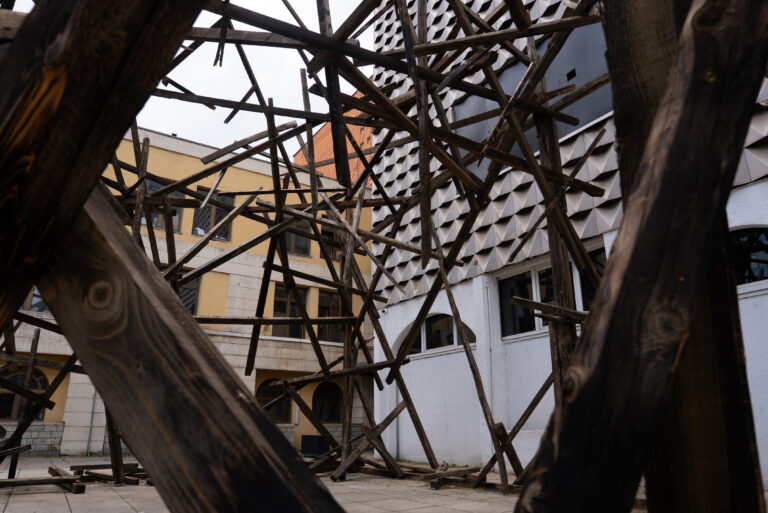
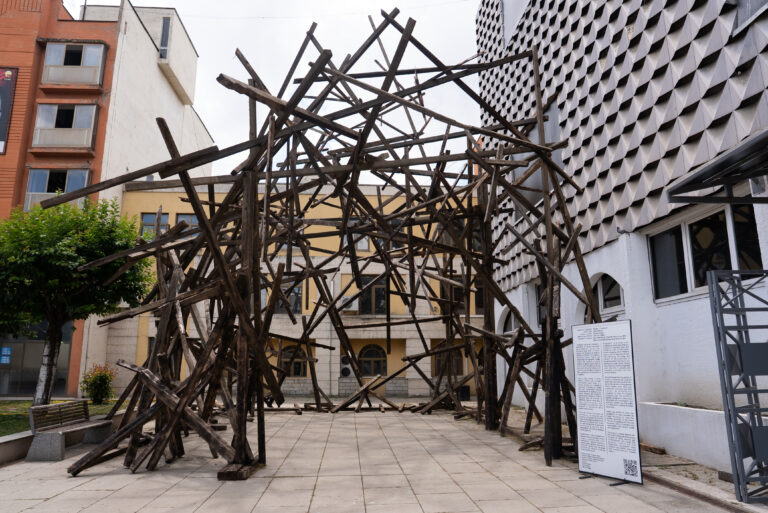
Reporting House is pleased to present “Flashbacks”, a large-scale installation by artist Agron Blakçori, curated by Gazmend Ejupi and installed in front of the former Gërmia department store in Prishtina, now home to the museum. The work brings the image and memory of homes burned during the war in Kosovo directly into public space, transforming one of the city’s most recognisable urban landmarks into a powerful and unsettling confrontation with an unresolved past.
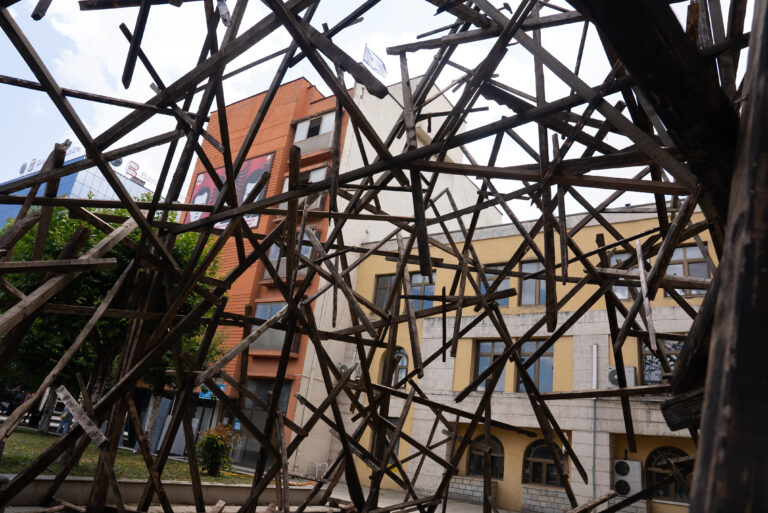
Rather than reconstructing a single house, Blakçori creates an abstract architecture of loss. Skeletal structures, fragmented frames and charred forms suggest rooms and roofs without fully restoring them. The work evokes the thousands of homes systematically burned during the war, not as neutral ruins, but as remnants of lived spaces where families once slept, ate, celebrated and planned their futures. By placing the installation in front of a former department store, the exhibition creates a deliberate contrast between a site once associated with consumption and the routines of everyday life, and the reality of destruction that marked an entire generation.
“Flashbacks” is conceived not as a work to be viewed from a distance, but as an invitation to enter. Visitors are invited and challenged to step inside the installation, move among its fragile structures and cross the invisible thresholds of lost rooms. The act of entering the work becomes a form of shared responsibility: one cannot remain merely a spectator. Moving through the installation means confronting the scale of absence through one’s own body, measuring oneself against the height of walls that no longer exist and experiencing the uncertainty of standing within a space that carries both memory and destruction. This invitation to enter lies at the heart of the curatorial approach, insisting that memory is not passive, but something that demands physical and emotional presence.
In dialogue with the façade of the former Gërmia department store, “Flashbacks” transforms the entrance of Reporting House into an open-air display. Where products and advertisements were once exhibited, the installation now “exhibits” absence. Passers-by need neither purchase a ticket nor enter the museum to encounter the work; they come across it on their way to work, school or a café. This direct encounter is central to curator Gazmend Ejupi’s vision, positioning the installation as a public reminder that the history of war and displacement is not confined to archives or distant villages, but woven into the very fabric of the city.
The project is closely connected to Reporting House’s mission as a museum of media, memory and contemporary art. Inside the building, visitors encounter testimonies, documents, film footage and artistic responses that recount Kosovo’s recent history. Outside, “Flashbacks” extends this narrative into space and architecture. The work functions as a spatial report: without using a single photograph, news headline or media clip, it speaks of what happened to people’s homes and of the intimate violence of forced displacement. For those who lived through the 1990s, the burned house remains a deeply personal image.
Blakçori’s work does not seek to monumentalise specific tragedies, but instead brings many experiences together within a shared, collective form through which people can walk, pause and remember from within. At the same time, “Flashbacks” is not solely about destruction. The openness of its structures, the way light passes through them and the fact that they remain standing rather than having collapsed entirely suggest a fragile yet persistent form of resilience. To enter the installation is also to enter a space where survival, perseverance and the possibility of return remain present. Nearly one million people became war refugees, yet this did not prevent them from returning en masse in June 1999, often to find their homes burned and looted. In this context, return does not mean coming back to an untouched home; it means reclaiming the right to remember, to speak, to rebuild and to inhabit the city without erasing what happened.
With this exhibition, Reporting House, together with artist Agron Blakçori and curator Gazmend Ejupi, reaffirms its commitment to creating spaces where art, memory and public life intersect. “Flashbacks” marks the threshold of the museum as a place where the past is not buried but continually revisited, and where each visitor is quietly challenged not only to look at history from the outside, but to step inside it.
Installation constructed by Open Art Gallery
Producer: Balkan Investigative Reporting Network
FLASHBACK - Agron Blakçori
FLASHBACK - Agron Blakçori